
Let's be honest about trading signals for a second. Most of what you find online is a screenshot of a winning trade, posted after the fact, from someone you can't check. The losing trades? Gone. Deleted. Never happened.
We built Zexca signals the other way round. They're free, they're specific, and every single one stays on the record — the ones that hit target and the ones that hit the stop.
What a Zexca signal actually gives you
Open a signal card in your Zexca account and you'll see the whole plan, not just a direction:
- The market and the side. Long or short on crypto; buy or sell on forex, gold and indices.
- An entry zone. A range, not a single price, because real markets don't wait for you at an exact tick.
- A stop loss. Where the idea is wrong and you're out.
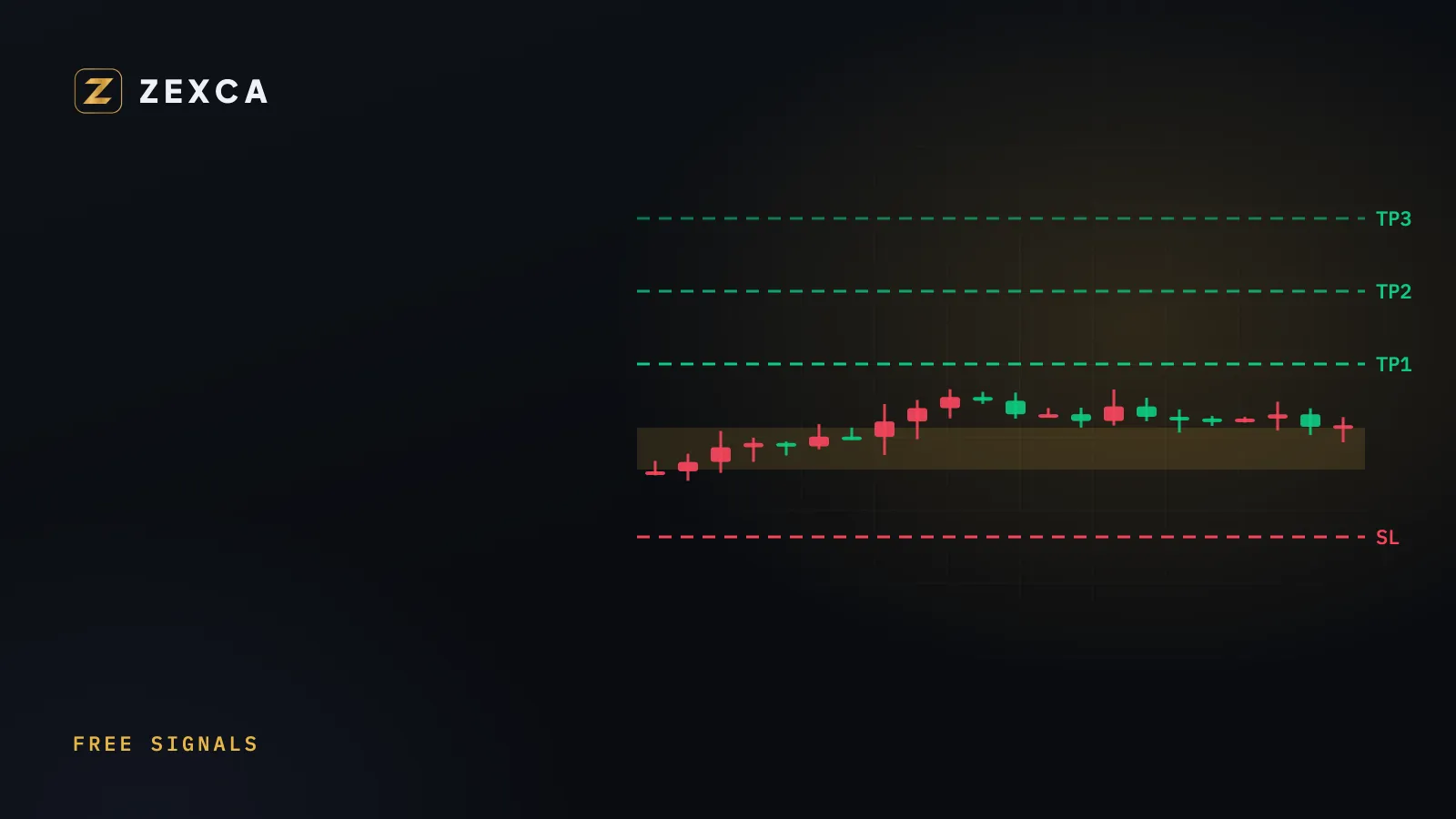
- Three take-profit targets. TP1, TP2 and TP3, each one further away. Next to every level you'll see how far it is from the entry, in percent.
- Leverage, for crypto signals only, where it's part of how the position is placed.
- A live price and live result, so you can see where the trade stands right now.
There's also a TradingView button on every card. It opens the chart on the same venue the signal is checked against, so the candles you look at are the candles that decide the result.
Four markets, one feed
Signals cover the four markets Zexca follows:
| Market | Examples |
|---|---|
| Forex | EUR/USD, GBP/USD, USD/JPY |
| Gold & metals | Gold, silver |
| Crypto | Bitcoin, Ethereum, Solana, and coins like XRP and HYPE |
| Stocks & indices | Nasdaq 100, S&P 500, Dow Jones, oil |
You can filter the signal page by market, so if you only care about gold, you only see gold.
How a signal closes (and why that matters)
Here's the part most signal channels skip. On Zexca, nobody decides by hand whether a trade "worked".
Every minute, the platform reads the real price bars for each open signal. The moment a candle touches a target or the stop, the signal closes on its own, and the result is written to your history. If one candle touches both a target and the stop, Zexca counts it as a stop. That's the cautious reading, and it means the record never looks better than what actually happened.
You get a notification when a signal opens and when it closes, with the result.
The record is the point
Open the Signals dashboard and you'll find the full picture: win rate, profit factor, the deepest drawdown, the longest winning and losing streaks, and month-by-month charts. It's built from every closed signal, losses included.
That's what "free signals" should mean. Not free screenshots. A free, complete, checkable record.
How to use free signals without getting hurt
A few honest habits go a long way:
- Never risk more than you can afford to lose on one trade. Many traders keep it to 1–2% of their account. Our guide on what a stop-loss is and where to put one walks through the math.
- Respect the stop. The stop is part of the signal. Moving it further away turns a planned loss into an unplanned one.
- Take something at TP1. Closing part of the position at the first target and letting the rest run is a common way to manage a trade.
- Learn why, not just what. Signals are a great way to study the market. Look at the chart, read the setup, and over time the "why" starts to make sense. That's what the Zexca Academy is for.
Where Milo fits in
Behind the signals is Milo, the Zexca market engine. Milo reads dozens of instruments every second — price, volatility, order flow, news and structure — and the same live view is open to you in the AI terminal. If you're curious how that works, meet Milo here.
Try it
Signals are free for every Zexca account. Open one, watch a few signals play out live, and judge the record for yourself. No screenshots required.
Educational content, not investment advice. Trading carries risk, including the loss of capital.