
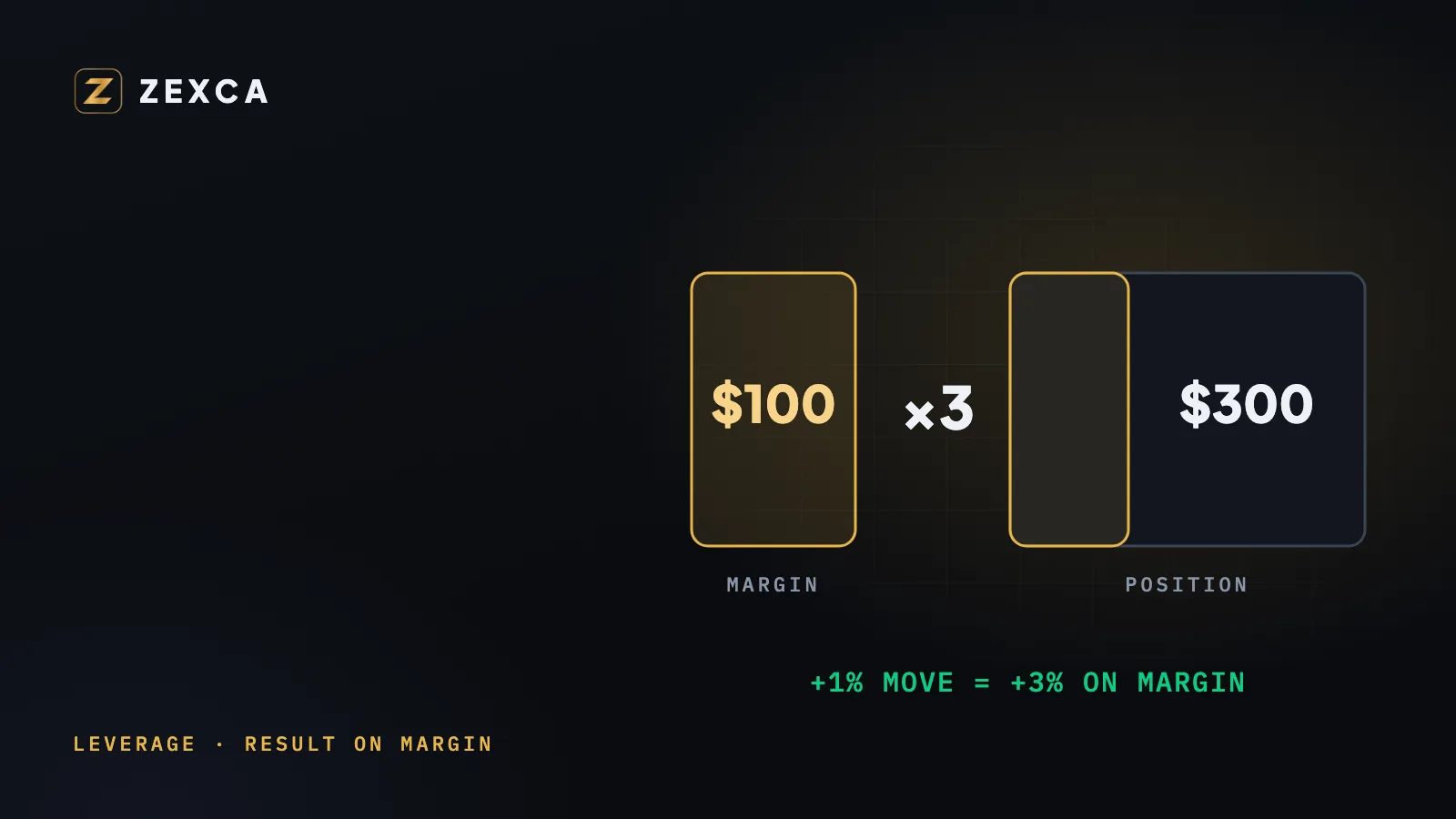
Leverage lets you open a position larger than the money you put down. With 3× leverage, $100 of your own money, the margin, controls a $300 position. That is the whole idea, and it cuts both ways: every move in the price is felt three times over on the $100.
This article explains how that works, how to read a result on margin, and how Zexca now shows it on every leveraged signal.
Price move and result on margin are two different numbers
Take a real signal from the Zexca record: SG-89021, a 3× short on Bitcoin. It was opened at 81,480 and closed at 80,469.
- The price move in the trade's favour was (81,480 − 80,469) ÷ 81,480 = 1.24%.
- With 3× leverage, the result on margin was 1.24% × 3 = 3.72%.
On $100 of margin, that is about $3.72. The price moved 1.24%; your money moved 3.72%.
Exchanges call the second number ROE (return on equity) or ROI, and it is the percentage you see beside an open position on a futures exchange. Since today, it is also the number Zexca shows on every leveraged signal card, in the history and on the Signals dashboard, with the bare price move written underneath so you can always check one against the other.
The same multiplier works against you
Leverage does not choose a side. The stop of a 3× signal that sits 4.65% from the entry costs 13.95% of the margin if it is hit. That is why the stop matters more, not less, when leverage is involved. If you are new to stops, read what a stop-loss is and where to put one first.
| Leverage | Price move | Result on margin |
|---|---|---|
| 1× | +2% | +2% |
| 3× | +2% | +6% |
| 10× | +2% | +20% |
| 10× | −2% | −20% |
Liquidation, roughly
If the price moves against a leveraged position far enough, the exchange closes it for you because the margin is gone. As a rough guide, the distance is about one divided by the leverage: around 33% at 3×, around 10% at 10×. In practice it comes a little earlier, because of fees and the maintenance margin each venue keeps.
A good signal places its stop well inside that distance, so the trade is closed by your plan rather than by the exchange. Every leveraged signal on the Zexca record so far has its stop well inside that distance, so the stop is reached long before liquidation would be.
How to use leverage sensibly
- Size first, leverage second. Decide how much of your account one trade may lose, then choose the position size. Leverage only changes how much margin that position ties up.
- Higher leverage is not a better signal. It makes the same idea louder in both directions.
- Read both numbers. The result on margin tells you what happened to your money; the price move tells you what the market actually did.
- Never move the stop because the position is leveraged. A wider stop at high leverage is how accounts get liquidated.
Where to see it on Zexca
Open Signals in the Zexca dashboard. A leveraged card shows its live result on margin in large figures and, under it, a line such as Price move +0.81% · 3×. The stop and target distances on the card use the same rule, and the free signals record, the win rate and the equity curve on the dashboard are all computed the same way.
Milo, the AI behind Zexca's market analysis, issues the levels; leverage decides how loudly they reach your account. Knowing the difference is the first step to using it well.
This article is education, not financial advice. Leveraged trading can lose more quickly than it gains.
Educational content, not investment advice. Trading carries risk, including the loss of capital.